

WATER WATCH
ALWAYS PROTECTED
-

WATER ENTERS
Condensation, contamination or poor fuel storage can introduce water into diesel and your factory fuel filter won’t stop it.
-

WATER IS DETECTED
Fuel passes through Water Watch and creates a vortex separating the water and particle.
-

WATER WATCH ALARMS
The Water Watch sensor detects as little as 5ml of water and alerts you through audio and visual.
-

DRAIN & DRIVE
Unscrew the sensor, drain the Water Watch, and continue your travels.


TWO STYLES. EQUALLY PROTECTED
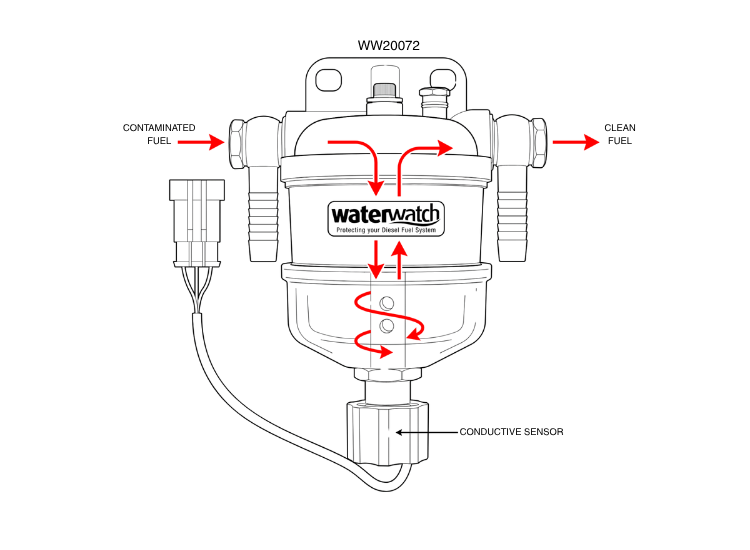
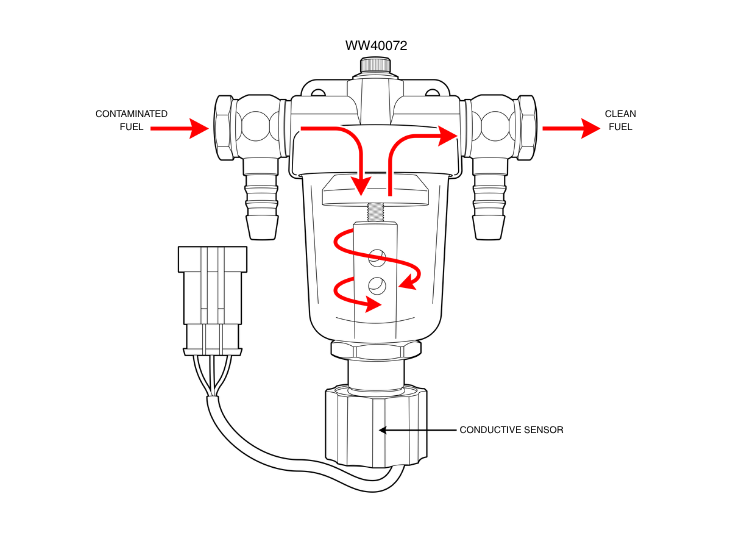
Diesel enters the Water Watch through a conical section and passes through a narrow gap along the top edge of the housing.
It then flows radially toward the centre and exits the unit.
Due to their higher density, water and particle are separated from the fuel through centrifugal force, pushing them out of the diesel.
The diesel's flow rate generates the necessary force to efficiently separate water and particle, keeping them at the bottom of the bowl, beneath the fuel flow.
Water Watch operates without any moving parts of filters, meaning there is no restriction to the fuel flow.
WHERE DOES IT SIT?
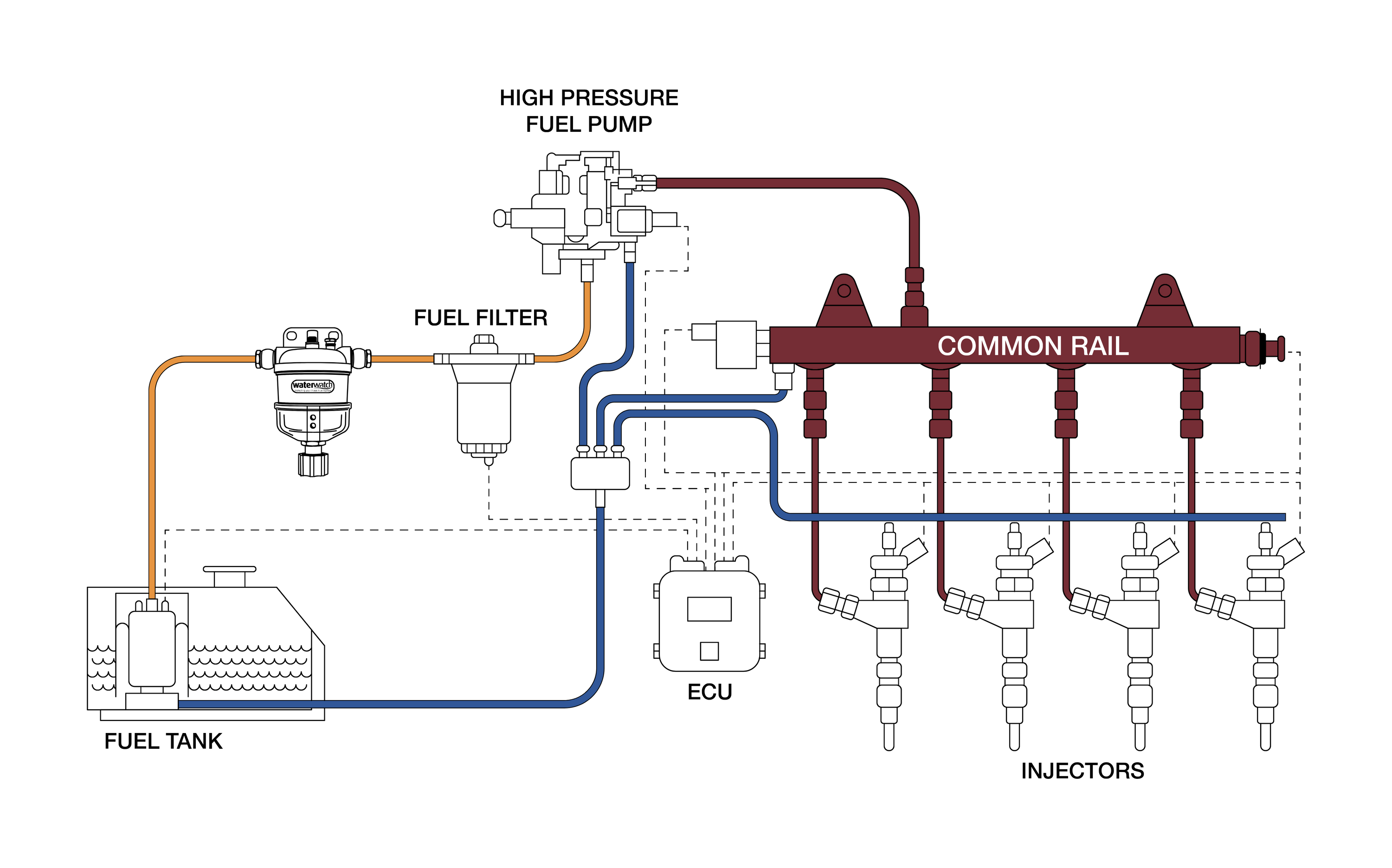
Water Watch is located in the supply line between the fuel tank and the factory fuel filter. Fuel in common rail diesel is also used to cool the system and can circulate up to approx. 70 litres per hour.
Scroll to see more ›
HOW DO WE COMPARE
Water Watch is located in the supply line from the fuel tank and before the factory fuel filter. Fuel in common rail diesel is also used to cool the system, so it circulates through the system up to 70 litres per hour.
Scroll to see more ›
✓ Yes - designed for common rail diesel fuel systems and separates water from the fuel.
✕ No - water under pressure will go through the filter.
✕ No - water under pressure will go through filter.
✓ Yes - works in modern vehicles but designed for low fuel flow rates.
✓ Yes - removes all particle that is heavier than diesel. Bowl allows for easy inspection.
✓ Yes - captures particle that is larger than the filter micron. A filter micron that is lower than the factory fuel filter will create a suction restriction.
✓ Yes - very good for particle removal.
✓ Yes - needs regular maintenance to ensure there isn't a build up. You cannot see into the unit and excess will flow through the system.
✓ No restriction - there is no filter to create a physical barrier or become clogged.
✕ Yes, causes restriction - creates a barrier from the paper medium and reduces fuel flow rate.
✓ Yes - however the vehicle is designed to accommodate the restriction caused by the factory fuel filter.
✓ No restriction - there is no filter to create a physical barrier or become clogged.
✓ Yes - highly sensitive alarm that activates with as little as 5ml.
✓ Yes - water will collect when fuel pressure and flow rate is low (restricted) and relies on gravity to work.
✓ Yes - water will collect when fuel pressure and flow rate is low (restricted) and relies on gravity to work.
✓ Yes - sensitivity of alarm can vary from poor to good.
5ml or 1tsp of water.
Approx. 30-200ml of water.
Approx. 50-200ml of water.
Approx. 50-100ml of water.
✓ Yes - designed to for both.
✓ No - causes a restriction to the fuel system.
✓ Yes - designed for the vehicle.
✓ No - can leak when there is high flow and pressure rates.
✓ Yes - designed for extreme temperature.
✓ No - plastic components are known to discolour and distort under high temperature, resulting in leakage.
✓ Yes - designed for the vehicle.
✓ Yes - generally not affected by temperature.
✓ No - requires no maintenance or replacement parts.
✕ Yes - requires regular maintenance.
✕ Yes - requires regular maintenance.
✕ Yes - requires regular maintenance.
Responsive Engineering Australia has provided a generalised summary on the secondary filter, factory fuel filter, and water trap. It is the buyers responsibility to undertaken their own due diligence when determining if Water Watch is right for them.
REAL REVIEWS
Your feedback is everything. We let our community speak for themselves. More reviews can be found on the product page.
"With the increasing prices of repairing damaged fuel systems due to poor-quality fuel, Water Watch is a small insurance policy that provides peace of mind while on the road. Thank you to the staff for recommending the system I purchased, which is fit for purpose."
"We picked up some dodgy fuel while doing a Kumho tyre test in western NSW. The alarm went off and we killed the engine immediately. In the bowl a tiny amount of water showed up as a silver layer - looking almost like mercury. We unclicked the electrical plug at the base of the unit and unscrewed the drain cap to let the water flow out. Then we tightened the drain cap, reconnected the electrical plug and away we went. The whole operation took around five minutes. We like the Water Watch very much and look forward to its fuel system protection, hopefully, for the next 15 years!"
"Been really happy with my Water Watch unit. It’s saved my engine from damage after picking up a bad batch of fuel from a ‘reputable’ service station. After sale support is first class. Would recommend without hesitation"
"Water watch has saved my fuel system for the second time in 4 years. After the alarm going off I was able to stop the vehicle and remove the water from Water Watch, change the fuel filter and continue on my trip without further problems."
"Awesome product, install was straight forward, instructions easy to follow, would highly recommend."
"I had a very expensive fuel problem on a Ford Ranger and the factory filter with a water in fuel light didn't pick it up until it went into limp mode. Ford refused to cover it on warrantee as they said the light must have been on for ages (it didn't come on until it was in limp mode!). To cut a long story short I eventually got paid by my insurance company for $13000 in repairs. I fitted a Water Watch fuel separator and have not had a problem since. I check the bowl every few days and have drained it a few times in about 50000 Km. This product is great insurance and money well spent."